


Precision Ag Update - June 2026
Can Precision Agriculture Detect Herbicide Resistance Before Spraying?
Written by Jennifer Lachowiec, June 2026
Wild oat (Avena fatua) remains one of the most troublesome weeds in Montana small grain production. Herbicide-resistant populations have become increasingly common, making weed management more difficult and increasing production costs. Determining whether a population is resistant typically requires greenhouse testing that can take weeks or months, leaving producers to make management decisions without complete information.
Researchers at Montana State University are exploring whether advanced sensors and artificial intelligence (AI) could eventually help identify herbicide-resistant wild oat before herbicides are applied. If successful, this approach could provide an entirely new way to support resistance management decisions.
Looking Beyond Herbicide Injury
In our study, we collected detailed spectral measurements from the leaves of greenhouse-grown wild oat plants with known multiple herbicide resistance characteristics. Importantly, all measurements were taken before herbicide application. This differs from many previous studies that detect plant responses after herbicides have already been applied. By focusing on untreated plants, we asked whether resistant and susceptible wild oat differ enough biologically to be recognized before a management decision is made.
What Have We Found So Far?
Preliminary results suggest that resistant and susceptible wild oat populations can often be distinguished using spectral measurements collected before herbicide application. Using AI tools, we were able to classify plants with promising accuracy under controlled greenhouse conditions. However, only six wild oat biotypes were included in this initial study. As a result, it remains unclear whether the models are detecting physiological characteristics associated with herbicide resistance itself or other unique features of the individual biotypes examined. Expanding the study to include a larger and more diverse collection of wild oat populations will be essential for determining how broadly these findings apply and whether a consistent spectral signature of herbicide resistance exists.
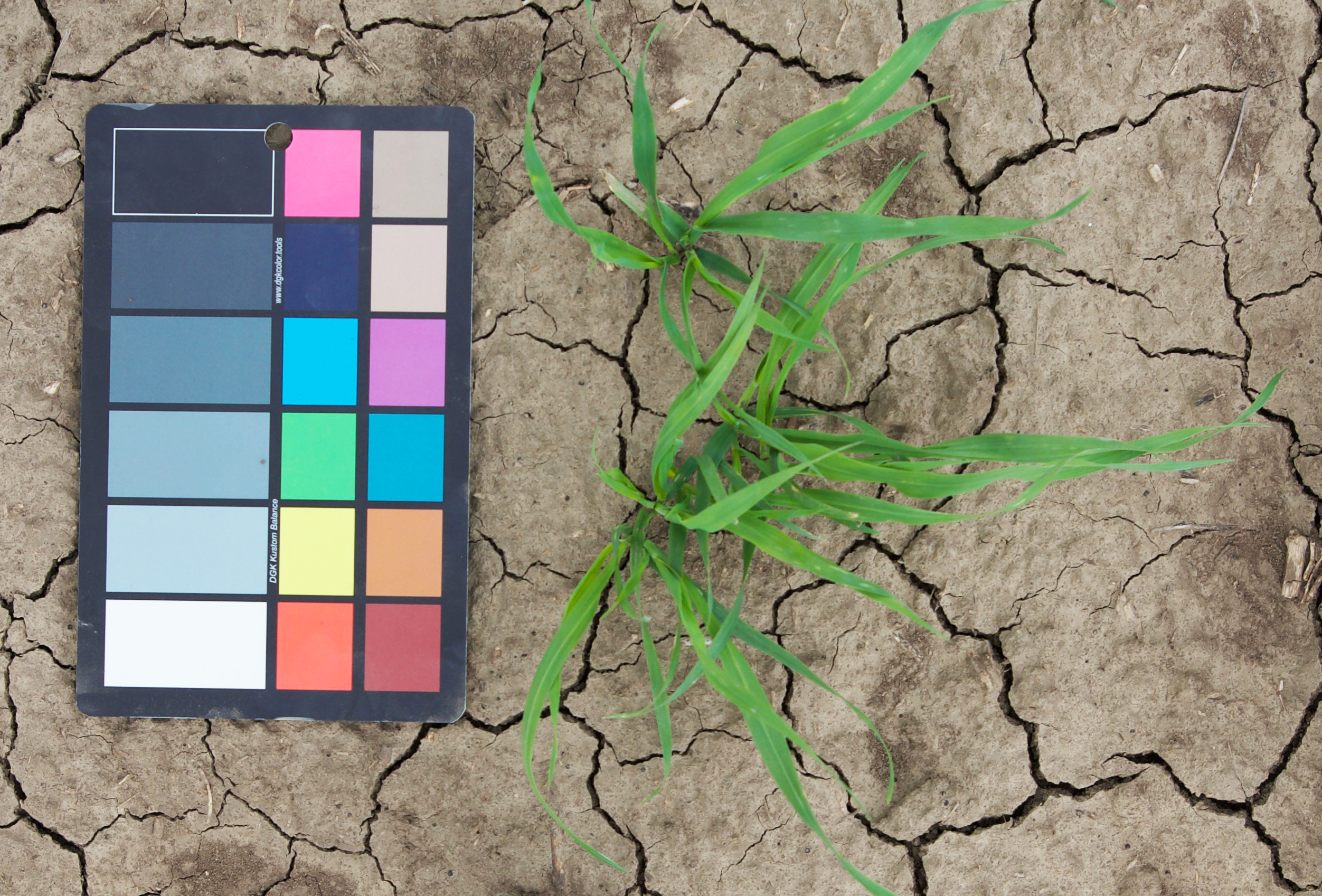
Figure 1. Wild oat (Avena fatua) with a color calibration target used for image analysis.
Why Does This Matter?
Current approaches for confirming herbicide resistance can be time-consuming and often occur after management decisions have already been made. If resistant populations possess detectable physiological differences before herbicide application, future sensing technologies could potentially provide earlier information to support weed management decisions.
While practical applications are still years away, this work demonstrates the potential for precision agriculture tools to contribute to resistance management in new ways. Rather than simply documenting the effects of herbicide application, future sensing systems may help identify resistant weeds before treatment decisions are made.
What's Next?
The research remains in the proof-of-concept stage. Measurements were collected from greenhouse-grown plants under controlled conditions, and substantial work remains to determine whether similar patterns can be detected under field conditions. Researchers are also interested in expanding the study to include a wider range of wild oat populations from across Montana to better capture the diversity of resistance mechanisms present in producers' fields.
Producers who suspect herbicide-resistant wild oat in their fields may be able to contribute valuable samples to future research efforts—please reach out! Expanding the number of populations included in the study will help us evaluate how broadly these findings apply across Montana's agricultural landscapes.
Acknowledgements
This project is funded by USDA-NIFA
Get Connected & Learn More

Jennifer Lachowiec
Associate Professor, Plant Genetics and Genomics, Diversity, Equity, Inclusion