


Precision Ag Update - March 2026
Precision Soil pH Management for Montana Grain Systems: Remote Sensing–Driven Early Warning, Targeted Liming, and Producer Decision Support
Written by: Shilan Felehgari and Paul Nugent, March 2026
Why Is Targeted Soil pH Management Needed in Montana Cropping Systems?
Soils in Montana are generally slightly alkaline (US Department of Agriculture, 2022); however, sustained reliance on ammonium (NH₄⁺)-based nitrogen fertilizers has increasingly driven soil acidification through nitrification-mediated proton (H⁺) release. (Hegedus 2022). Soil pH exhibits pronounced sub-field heterogeneity at spatial scales ranging from meters to tens of meters, such that acidification typically initiates in discrete zones and progressively expands. This fine-scale variability renders uniform, whole-field liming strategies both economically inefficient, highly labor-intensive and agronomically imprecise. Automated soil sampling systems, such as the Veris MSP3 soil scanning sensor (Veris Technologies, Salinas, KS), which can be mounted on agricultural machinery, have been proposed for high-resolution soil pH assessment (Jones et al., 2021). However, these systems are costly, time-consuming to operate, and can only be deployed within narrow field windows to avoid crop damage. As a result, their widespread adoption remains limited. Remote sensing has therefore been proposed as a viable alternative for achieving affordable, spatially continuous, and high-resolution mapping of soil and vegetation properties without extensive in-field data collection. Recent advances in remote sensing, including higher-resolution satellite platforms, emerging optical missions, and airborne or UAS-based observations, offer a timely opportunity to develop multi-scale, data-fusion frameworks that integrate synoptic coverage with fine-scale spatial detail.
What we have evaluated
In this note, we evaluate a satellite-based framework for soil pH estimation using multi-temporal Landsat-9 observations acquired under near-bare-soil conditions. In Montana’s dryland cropping systems with no-till practices, true bare-soil periods do not exist. However, the low crop residue following pulse crops and even some cereal crops provides sufficient soil views for soil pH monitoring. This provides post-harvest or fallow-year observation windows, facilitating enhanced detection of within-field variability and enabling more informed, site-specific management decisions. Building on prior satellite-based true bare-soil pH modeling efforts, this study advances the field by evaluating a Soil pH Index (SpHI) derived from multi-temporal Landsat-9 imagery. By leveraging Landsat-9’s improved spectral characteristics, the proposed approach enhances spatial fidelity, reduces predictive uncertainty, and supports scalable, cost-effective soil pH mapping validated against in situ measurements. The SpHI model (Eq 1), integrates surface reflectance data from five critical spectral bands of the Landsat-9 sensor: Band 2 (Blue), Band 3 (Green), Band 4 (Red), Band 6 (Shortwave Infrared 1), and Band 7 (Shortwave Infrared 2) (Barletta et al. 2023). These bands were carefully selected based on their proven sensitivity to key soil chemical and physical attributes, such as organic matter content, moisture levels, iron oxide presence, and mineral composition, that directly or indirectly affect soil pH variability (Sun et al. 2025), and validated in our own work through statistical analysis. Unique Montana coefficients for each band were derived, and performance was evaluated based on the coefficient of determination (R²), which indicates the goodness of fit between predicted and observed pH values.
pH = 6.51 – 35.11 (B2) - 52.28 (B3) + 1.08 (B4) + 30.03 (B6) - 8.22 (B7) Eq. 1
Site Description and Study Area
The SpHI model was evaluated for soil pH monitoring across two study sites in Montana. Site A (Fig. 1a) is located at the Montana State University Lutz Research Farm near Bozeman, Montana, and covers approximately 74 acres, while Site B (Fig. 1b) is a producer-managed agricultural field near Fort Benton, Montana, encompassing approximately 321 acres. Although both sites are located in Montana, they differ markedly in climatic conditions and soil geomorphological characteristics, providing a robust framework for assessing model performance across contrasting environments.
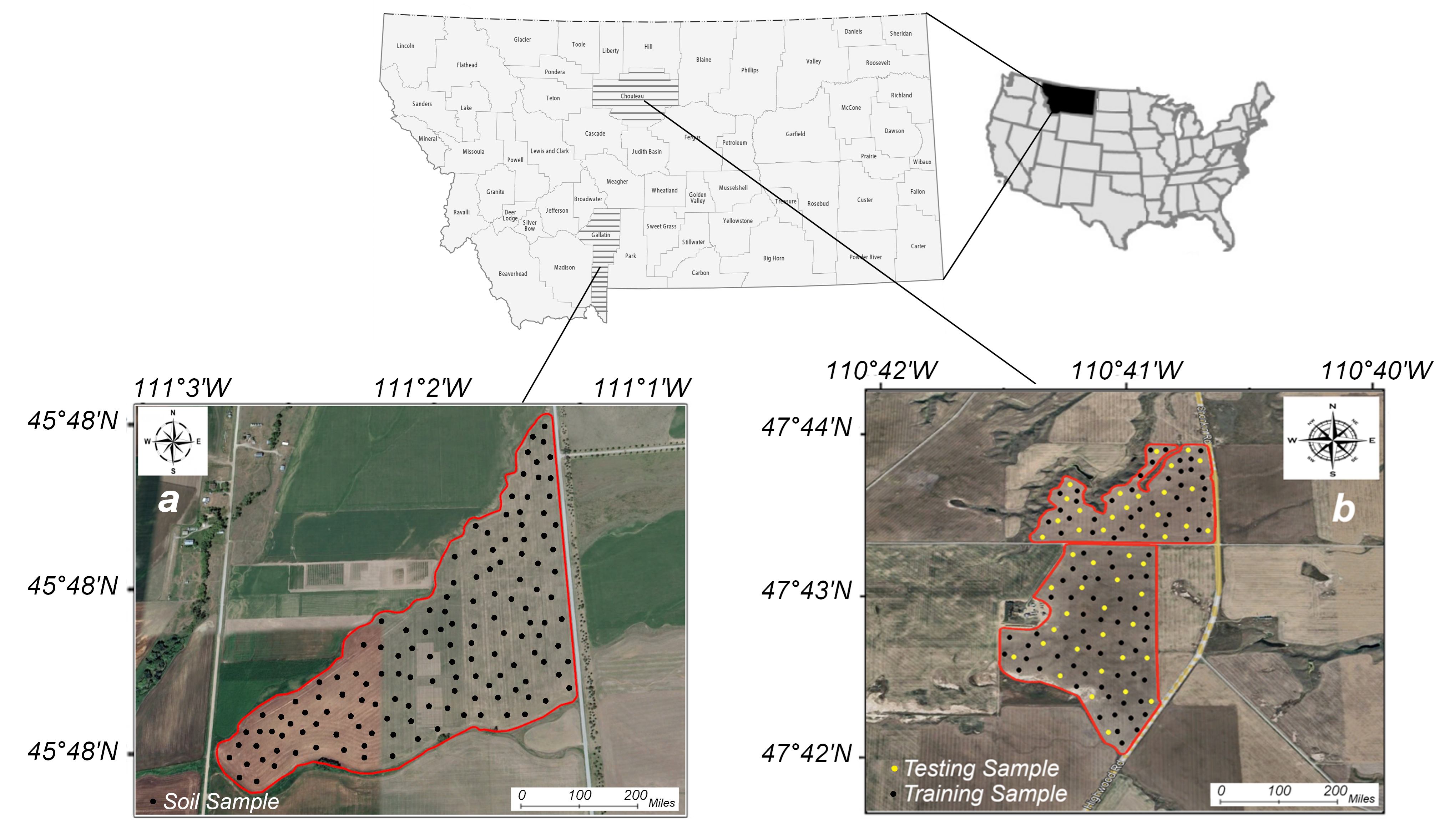
Figure 1. Location of the study area.
Ground Truth Data Collection
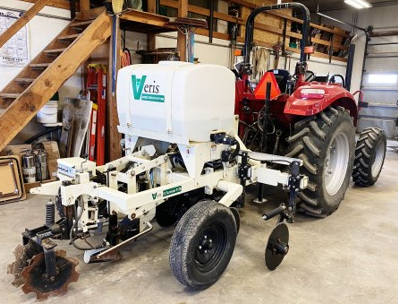
During a field survey in July 2023, 300 soil pH measurement samples were taken with the Veris MSP3 (Fig. 2), using the pH sampler to sample soil from a depth of 40 mm to 80 mm (150 points from site A and 150 points from site B). The samples were taken from a depth of 5 cm to 10 cm and were later used to calibrate and validate the predictive model. The Veris MSP3 was selected due to its ability to provide rapid, high-resolution, and spatially continuous in situ soil pH measurements (Schirrmann et al. 2011). In-field soil pH values ranged from 5.10 to 6.04 at Site a and from 5.30 to 7.10 at Site b. Field data were required to generate a reference soil pH map, which was subsequently compared with soil pH estimates derived from the SpHI model.
 |
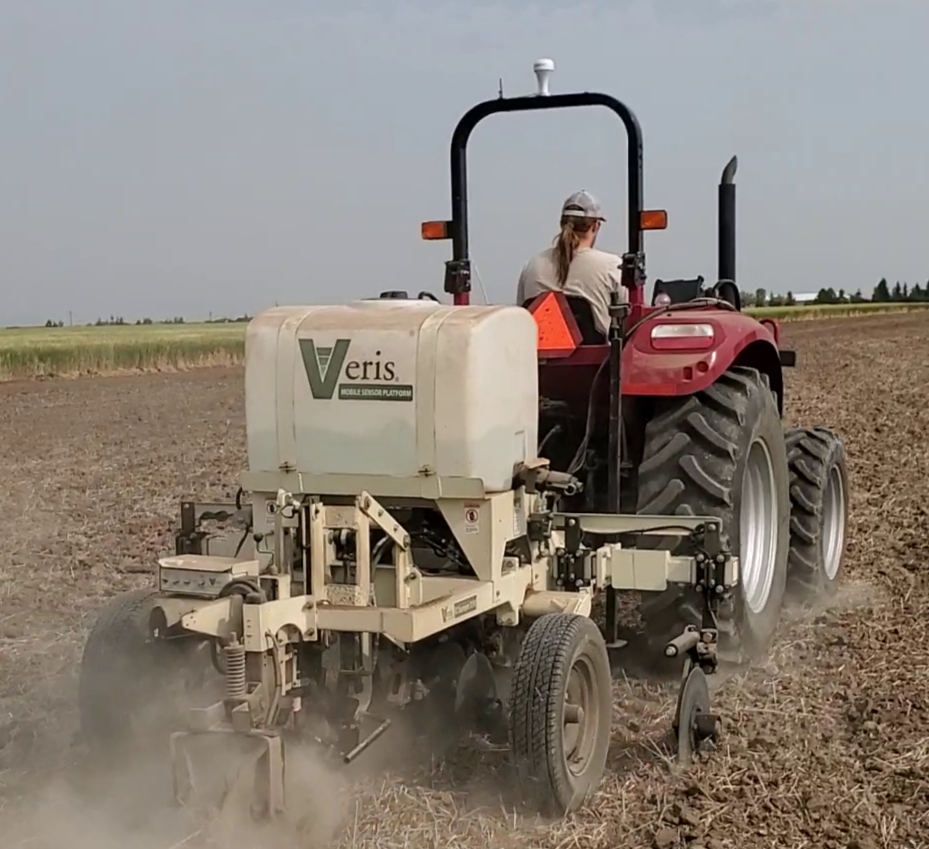 |
Figure 2. Veris MSP3 system was used for in-situ soil pH data collection during the field survey.
Remote Sensing Data
Satellite images from the Landsat 9 Operational Land Imager (OLI) were used in this study. The OLI sensor provides seven multispectral bands in the visible to shortwave infrared (VIS–SWIR) region, each with a spatial resolution of 30 meters (Barletta et al. 2023. In this study retained only those bands that demonstrated a positive coefficient of determination (R² > 0) with soil pH for inclusion in the final model (B2, B3, B4, B6 and B7) (Table 1). Two distinct Landsat-9 images acquired in July 2023 were selected, with acquisition dates carefully aligned with the field data collection period. During this period, vegetation was absent from the study area, thereby minimizing its influence on the soil spectral signatures. Comprehensive details of the two satellite images employed in this investigation are outlined in Table 2.
|
Table 1. Landsat 9 bands classification based on coefficient of determination (R2). |
|||||
|
|
B2 |
B3 |
B4 |
B6 |
B7 |
|
R2 |
0.012 |
0.021 |
0.010 |
0.042 |
0.038 |
|
Sensitivity |
Weak |
Weak |
Weak |
Weak |
Weak |
Research Questions
Building on the remote sensing and field datasets described above, we focused on three key questions:
- Early detection: Can multi-temporal Landsat-9 imagery reliably detect early, within-field soil acidification during bare-soil periods in Montana dryland grain systems?
- Accuracy and robustness: How accurately does the Landsat-9–derived SpHI model predict in-field soil pH compared to high-resolution Veris MSP3 measurements, and is performance consistent across sites and acquisition dates?
- Management relevance: Can satellite-derived soil pH maps capture fine-scale spatial variability sufficient to support targeted liming and site-specific soil pH management?
Key Findings
- Model performance: The SpHI model demonstrated strong predictive capability across both study sites (Table 3). High coefficients of determination were obtained for Site a (R² = 0.86) and Site b (R² = 0.83), indicating robust agreement between model-predicted soil pH and in-field measurements acquired using the Veris MSP3 system.
- Prediction accuracy: Across both Landsat-9 acquisition periods (25 June–11 July and 11–27 July), the model achieved low prediction errors (Table 3). The average RMSE and PRMSE values were 0.29 and 5.25%, respectively. Site A exhibited slightly lower prediction errors (RMSE = 0.26; PRMSE = 4.75%) compared to Site B (RMSE = 0.32; PRMSE = 5.75%), reflecting improved model performance in the smaller field.
- Soil pH range characterization: For Site a, modeled soil pH values ranged from 5.28 to 6.20, closely matching the field-measured range of 5.10 – 6.04, with a mean predicted pH of 5.74 (Table 3 & Fig. 3). In contrast, Site b exhibited a wider pH variability, with model predictions spanning 5.64–7.28 and field measurements ranging from 5.32 to 7.10, resulting in a higher mean pH of 6.40. These numerical patterns are spatially illustrated in Fig. 3.
- Temporal consistency: Model performance metrics showed minimal variation between the two Landsat-9 image dates (Table 3), demonstrating strong temporal robustness of the soil pH estimation during the late-June to late-July growing season.
- Spatial agreement between measured and predicted maps: As shown in Fig. 3, soil pH maps derived from model predictions closely reproduced the spatial patterns observed in field measurements. In Site A, higher pH values were consistently detected in the eastern portion of the field, while lower pH zones were concentrated in the southern and northwestern areas. In Site B, elevated pH values were predominantly observed in the central and southwestern regions, whereas lower pH zones were identified in the northern and northeastern portions of the field.
- Bias assessment: A slight positive bias was observed, with model-predicted pH values marginally higher than in-field measurements; however, the discrepancies remained consistently below 10% for both sites, indicating no substantial systematic overestimation.
- Overall reliability: Despite the relatively weak sensitivity of individual spectral bands (Table 1), their combined integration within the modeling framework enabled effective detection of soil pH variability. The strong numerical agreement and spatial correspondence (Fig. 3) between predicted and measured soil pH maps highlight the model’s ability to capture fine-scale, within-field soil pH heterogeneity.
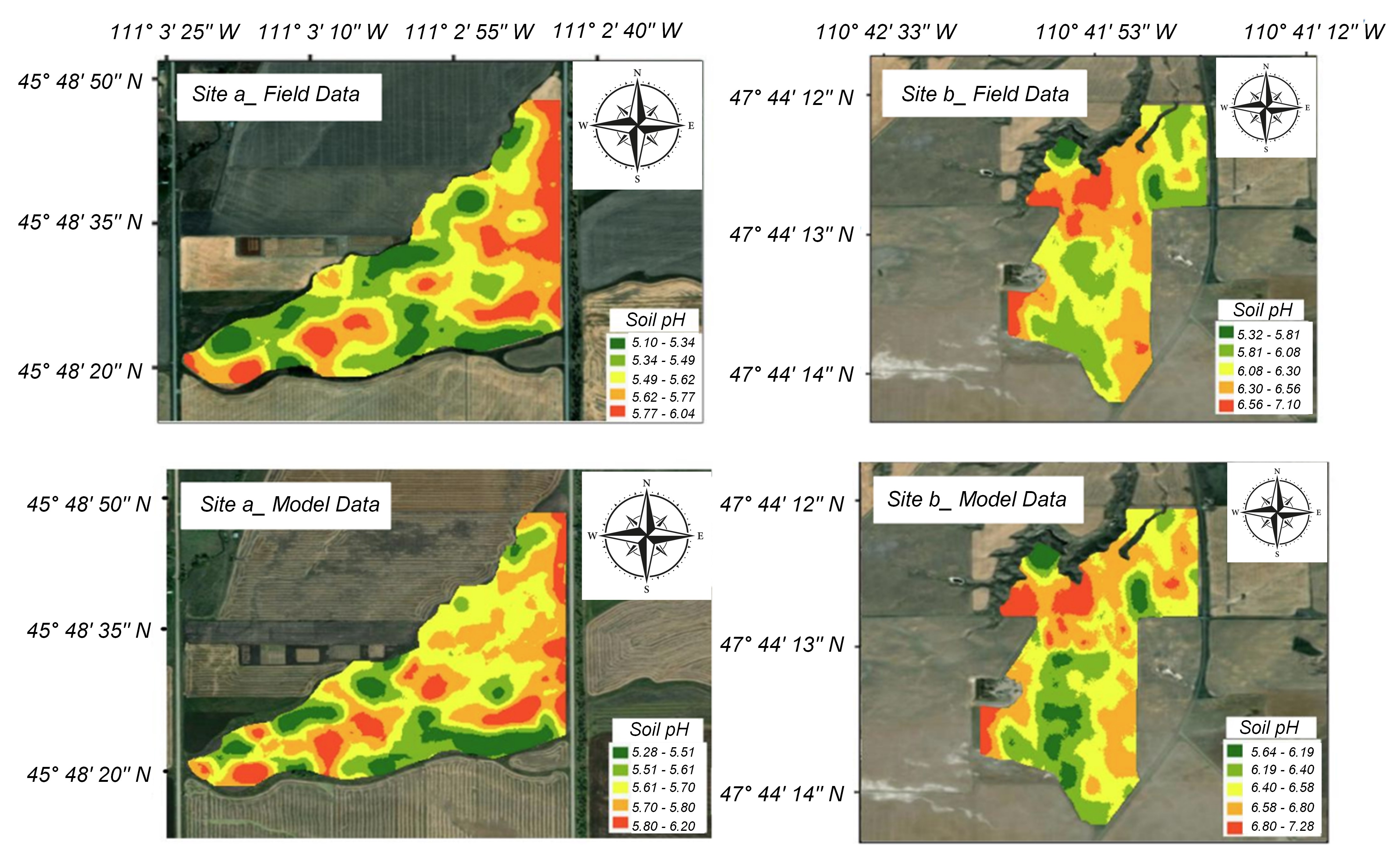
Figure 3. Estimation result of soil pH from field measurements (top) and model predictions (bottom).
Implications of Key Findings for Research Questions
Taken together, these key findings provide a robust empirical foundation for addressing the research questions that motivated this study. The results demonstrate that:
- Multi-temporal Landsat-9 imagery acquired during bare-soil periods can reliably detect within-field soil acidity and variability in Montana drylands.
- The SpHI showed strong agreement with high-resolution Veris MSP3 measurements, achieving high predictive accuracy and temporal robustness across sites and acquisition dates.
- The close spatial correspondence between predicted and measured soil pH maps confirms that satellite-derived products can capture fine-scale variability sufficient to support targeted liming and site-specific soil pH management.
Considerations Before Adopting Precision Soil pH Management
While the results demonstrate strong potential for satellite-based soil pH monitoring and targeted liming in Montana farms, several key considerations should be addressed prior to operational adoption.
First, timing and surface conditions are critical. Reliable soil pH estimation using optical satellite imagery requires near-bare-soil conditions with minimal vegetation cover and residue interference. In no-till Montana dryland systems, these optimal windows are found following low-residue crops, such as pulses, after harvest. Second, field-scale calibration remains essential. Although the SpHI framework demonstrated strong predictive performance, periodic in-field measurements (e.g., Veris MSP3 or soil sampling) are still necessary to calibrate, validate, and update model outputs. Satellite-derived maps have the potential to act as a decision-support layer rather, indicating potential acidity, variability, and guiding ground truth sampling, rather than a full replacement for ground truth data.
Third, spatial resolution constraints must be acknowledged. Landsat-9’s 30 m spatial resolution is sufficient to detect broad within-field pH patterns, management zones, and guide broad liming applications, but may not capture very fine-scale variability driven by micro-topography, sharp soil boundaries, historic field operations, or localized fertilizer application. Integration with higher-resolution platforms (e.g., UAV or commercial satellite data) may further enhance management precision in some fields.
Finally, producer engagement and decision-support tools are essential for adoption. For satellite-derived soil pH products to be operationally useful, outputs must be delivered through intuitive maps, zone-based recommendations, and integration with variable-rate application systems. The tool presented here is still under development and not yet broadly released. However, extension support and producer training will play a critical role in ensuring confidence, interpretability, and long-term adoption.
Summary
- Landsat-9 imagery effectively captured within-field soil pH variability, with strong agreement between model predictions and Veris MSP3 measurements across both study sites, demonstrating the reliability of remote sensing–based soil pH estimation.
- Visible and shortwave infrared bands (Blue, Green, Red, SWIR) were most sensitive to soil pH variability, and the pixel-based mapping approach successfully characterized both mean conditions and spatial dispersion of soil pH.
- Future research should extend temporal coverage and integrate sensors with higher spectral resolution or more frequent revisit times to improve soil pH characterization and better capture SWIR–pH relationships.
Acknowledgements
We gratefully acknowledge the Northern Agricultural Research Center (NARC) Precision Agriculture Program for inviting us to share the results of this study and for their continued support of applied research that advances precision agriculture in Montana. We also thank the Department of Land Resources & Environmental Sciences, College of Agriculture, Montana State University, for supporting this research from its initiation through completion.
References
Barletta, C., Capolupo, A., & Tarantino, E. (2023). Extracting Land Surface Albedo from Landsat 9 Data in GEE Platform to Support Climate Change Analysis. Geomatics and Environmental Engineering, 17(6). https://doi.org/10.7494/geom.2023.17.6.35
Hegedus, P. B. (2022). Optimizing site-specific nitrogen fertilizer management based on maximized profit and minimized pollution. Montana State University, Bozeman, College of Agriculture. https://scholarworks.montana.edu/handle/1/16982.
Jones, C., Engel, R., Ewing, S., Miller, P., Olson-Rutz, K., & Powell, S. (2015). MONTANA FERTILIZER eFACTS Soil Acidification: An Emerging Problem in Montana. https://landresources.montana.edu/fertilizerfacts/documents/FF78AcidifIntro.pdf
Schirrmann, M., Gebbers, R., Kramer, E., & Seidel, J. (2011). Soil pH mapping with an on-the-go sensor. Sensors, 11(1). https://doi.org/10.3390/s110100573
Sun, W., Liu, S., Jiang, L., Zhou, B., Zhang, X., Shang, K., Jiang, W., & Jiang, Z. (2025). Prediction and monitoring of soil pH using field reflectance spectroscopy and time-series Sentinel-2 remote sensing imagery. Geomatica, 77(1). https://doi.org/10.1016/j.geomat.2025.100053
US Department of Agriculture Natural Resource Conservation Service Plant Material Plants for Saline to Sodic Soil Conditions in Montana and Wyoming. (2022).
Get Connected & Learn More

Dr. Shilan Felehgari
Assistant Research Professor Soil Science and Remote Sensing
(406) 994-2174
shilan.felehgari@montana.edu