


Precision Ag Update - May 2026
From drones to AI: Machine Learning Assisted Selection for Forage Winter Wheat Breeding Lines
Written by: Ricardo Leiton, Arpit Gaur and Suchismita Mondal, May 2026
Summary
Use of artificial intelligence in agriculture is an emerging topic. As such, crop breeding programs are evaluating the potential of using machine learning (ML) tools to support variety development processes. The researchers in the Winter Wheat breeding program at Montana State University are working on the core idea of leveraging ML in analyzing multispectral image data collected across the crop cycle and multiple cropping cycles to make meaningful predictions of the performance of breeding lines and, specifically, selection of high biomass forage winter wheat breeding lines. For growers and forage producers, this means the breeding program can more quickly and accurately identify winter wheat lines that offer strong biomass potential, better standability, and improved overall performance. In the long run, this approach helps deliver better varieties to the field.
Methods
From 2023 to 2025, drone-based aerial imaging data was collected in 5 different days (D1, D2, D3, D4, and D5) from Forage Observation nursery (FO) and Winter Cereal Forage trial (WCF) grown at the Arthur H Post Agronomy Farm, Montana Agriculture Experiment Station at Bozeman, MT (Figure 1). Multispectral images were processed using Pix4D mapper to create orthomosiacs and QGIS software was used to extract plot level values for red, green, blue, near-infrared and rededge spectral bands. This data was further used to estimate vegetation indices (VIs) associated with crop biomass, crop water status, and adaptation. In parallel, heading date, plant height, forage biomass, and grain yield were collected from each plot. To estimate forage biomass yield (FY), plant samples were cut from a 3ft long section of the plot, dried in an oven and weighed. The raw spectral values, VIs and FY values were used to train ML algorithms such as Regularized Generalized Linear Model, K-Nearest Neighbor, Artificial Neural Network, Support Vector Machine with Radial Basis kernel and Random Forest machine learning models for biomass prediction in forage winter wheat breeding lines. Two different tests were conducted with the data, one is internal testing, where all data was randomly divided to 80:20 that is 80% of the data was used to train ML algorithms to predict performance of 20% of the test lines and the accuracy of this prediction was measured by comparing the actual FY to the predicted FY. The external testing where all FO data was used as training to predict performance of WCF lines. External testing serves an important purpose to understand the potential of ML algorithms in predicting performance of breeding lines that have not been tested for FY. FY predictions were done following a 10-fold cross validation, by which an average of the accuracy % was calculated.
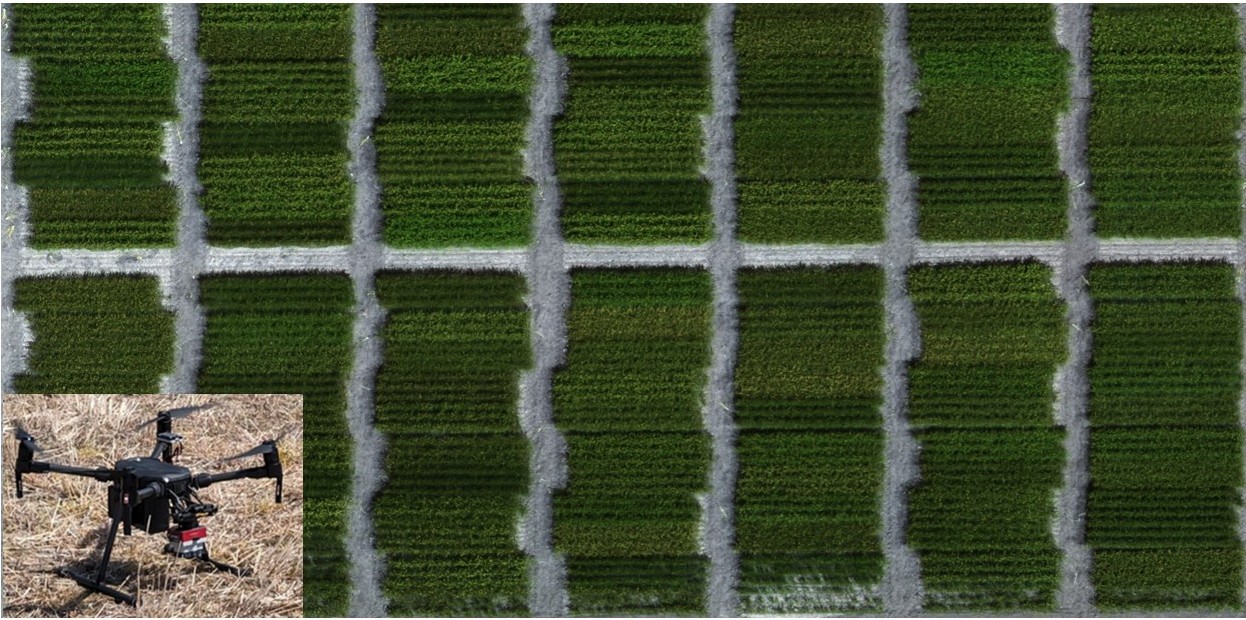
Figure 1. DJI Matrice 200 drone with Micasense Rededge-P multispectral sensor used in this study and aerial image of forage trials
What we observed
The integration of multispectral imagery and ML models emerged as a promising approach for predicting FY in winter wheat. Across the different ML models and imaging dates, internal testing showed prediction accuracies ranging from 66.7% to 73.1%, while external testing showed a wider range of 24.6% to 70.1%. Among all imaging dates, data collected at the tillering stage (D2) produced the most accurate predictions. Overall, these results demonstrate that multispectral imagery, especially when collected early in the season can be effectively paired with ML models to support better selection decisions in forage winter wheat breeding.
Implications
This study demonstrated that ML tools can assist in teasing out the large-scale drone-based aerial imaging data to predict breeding line performance and support selection decisions.
Acknowledgements
We would like to thank the Montana Wheat and Barley Committee for their support in initiating drone-based aerial imaging of winter wheat breeding plots at Bozeman and USDA-NIFA for their support in conducting forage winter wheat breeding trials. We would also like to thank all staff in the Winter Wheat Breeding Program involved in managing the trial.
Funding
This project is funded by Montana Wheat and Barley Committee, and USDA-NIFA.
Get Connected & Learn More

Ricardo Leiton
M.S. Student

Arpit Gaur
Postdoctoral Researcher