


2025 Optimizing Boron Management for Sustainable Wheat Production and Soil Health in Montana
Marilyn Dalen, Emily McGarvey, and Jessica Torrion
Objective
The purpose of this study is to determine the impact of Boron soil application to improve wheat seed set, yield, and quality under rainfed growing conditions.
Summary
This study was laid out in a split-plot design, replicated three times. The main plot factor was the Boron (B) applied as liquid and granular amendments at rates of 0.0, 1.0, 2.0, 3.0 lbs/acre. Five varieties of wheat were the subplot factors. Subplot factors were randomly arranged within the main plot factor. The study was in rainfed conditions (see Table 1 for management information). Plots were monitored for signs of B toxicity, including thickened stems and curled leaves. Three heads were collected from each plot to examine pollen viability at the flowering stage and to analyze amounts of B in the tissue. At physiological maturity, 10 heads were collected and analyzed for seed set, in addition to the standard thousand kernel weight (or seed size), yield, and quality metrics. Soil samples from 0-3, 3-6, 0-6, and 6-12 inches were collected in each block for N, P, K, soil organic carbon (SOC), pH, Mg2+, Ca2+, and B analysis.
Results showed that there was no significant difference in grain yield with the application of Boron (Table 2). However, numerically, applications of 1 and 2 lbs/Ac of Boron showed numerical grain yield trend to about 4.0 bu/ac with the highest B application showed a diminishing yield trend. The application of 1.0 lb/Ac was the minimum rate that improved grain protein content, thousand kernel weight, test weight, and falling number (Figures 2-5).
All varieties had the same yield and falling numbers above critical levels (Table 2). Dagmar and Lanning had the highest protein. Dagmar outperformed other varieties for test weight and thousand kernel weight.
Table 1. Management Information
|
Seeding date: |
4/22/2025 (112 Julian) |
Field Location: |
R6 |
|---|---|---|---|
|
Seeding rate: |
26 Seeds/ft2 |
Harvest date: |
8/18/2025 (225 Julian) |
|
Previous crop: |
Canola |
Soil type: |
Creston silt loam |
|
Herbicide: |
Axial Bold Cleansweep |
Tillage: |
Conventional |
|
Soil residual nutrients (N, P, K lb/A): |
66-8-140 (Fall, 2024) |
||
|
Insecticide: |
N/A |
||
|
Nutrient fertilizer applied (N,P,K lb/A): |
208-77-161 (at planting) |
||
|
Fungicide: |
N/A |
Table 2. Yield, yield component, and quality of spring wheat in response to different B sources and rates. |
|||||
|---|---|---|---|---|---|
| Yield, yield component, and quality | Variety | ||||
| Dagmar | Lanning | MT Carlson | MT Ubet | Vida | |
| Grain yield (bu/a)1 | 88.1a | 88.1a | 88.9a | 89.3a | 92.0a |
| Grain protein content (%) | 15.4a | 15.1a | 14.3c | 14.6b | 14.8b |
| Test weight (lb/bu) | 63.2a | 62.9b | 61.9e | 62.1d | 62.7c |
| 1000 seed weight (g) | 47.4a | 44.9b | 45.5b | 44.1c | 43.6c |
| Falling number (seconds) | 466b | 421c | 437c | 505a | 388d |
1Yield data adjusted to 13% moisture.
Note: The same letter assignment denotes non-significance at α=0.05.

Figure 1. Yield response with Boron application. The same letter assignment denotes an insignificant difference at α =0.05.

Figure 2. Protein concentration with Boron application. The same letter assignment denotes an insignificant difference at α =0.05.
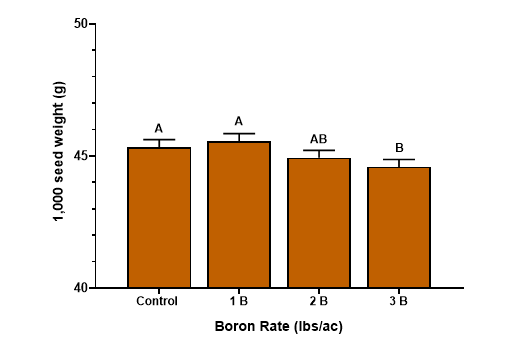
Figure 3. Thousand (1,000) Kernel Weight with Boron application. The same letter assignment denotes an insignificant difference at α =0.05.
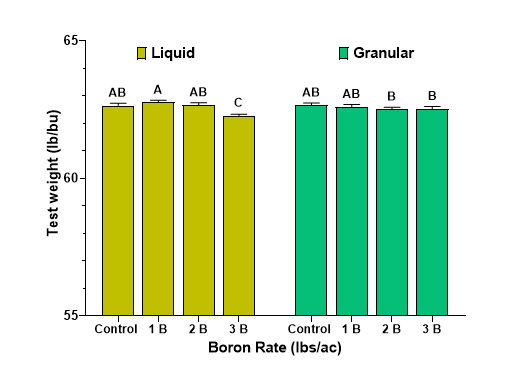
Figure 4. Test weight with Boron application. The same letter assignment denotes an insignificant difference at α =0.05.

Figure 5. Falling number with Boron application. The same letter assignment denotes an insignificant difference at α =0.05.
Acknowledgements
We thank farm operations staff J. Penney and A. Goodman, without whom this research could not be successful. We also acknowledge R. Barnes, T. Burkhart, J. Cain, A. Mathison, and E. Schreifels for their assistance with field operations, data collection, and sample processing. This study was supported by the Montana Fertilizer Advisory Committee (MFAC).
Link to 2025 Optimizing Boron Management for Sustainable Wheat Production and Soil Health in Montana Printable Report (PDF)