


2025 Evaluating the Effects of Silicon and Nitrogen Fertilization on Spring Wheat
Marilyn Dalen, Emily McGarvey, and Jessica Torrion
Objective
The purpose of this study is to establish a Silicon (Si) application source and rate that can optimize wheat grain yield and quality under low and sufficient Nitrogen (N) rates
Summary
This study was laid out in a split-split-plot design replicated three times where the main plot was N treatment; control (residual) and 150 lbs N/ac (residual + added N). The subplots were four Si rates (0, 0.5, 1.0, and 2.0 t/ac). The sub-subplots were three Si sources (Wollastonite, Silicate slag, and volcanic ash). Two varieties (Dagmar and Vida) were completely randomized within the Si source sub-subplot factor. This study was under rainfed (see Table 1 for management information).
Our initial results showed no significant difference for Si source and rate application on grain yield or grain protein of spring wheat (Figures 1, 2, and 3). The significant difference in grain yield and protein content was influenced by Nitrogen application. Our results showed that slag may increase falling number which remains to be verified (Figure 4). Between the two varieties used, Vida showed higher grain yield than Dagmar. However, Dagmar performed better in terms of grain protein, thousand kernel weight, and falling number (Table 2).
No significant effect of Si application was observed in 2025; this can be attributed to an inherently high soil pH (>7.0) at the experimental site. Plants tend to respond to Si application under acidic soil. To verify these results, this study will be established under acidic soil conditions in 2026.
Table 1. Management Information |
|||
|---|---|---|---|
|
Seeding date: |
4/22/2025 (112 Julian) |
Field Location: |
R6 |
|
Seeding rate: |
26 Seeds/ft2 |
Harvest date: |
8/12/2025 (224 Julian) |
|
Previous crop: |
Canola |
Soil type: |
Creston silt loam |
|
Herbicide: |
Axial Bold Cleansweep |
Tillage: |
Conventional |
|
Soil residual nutrient (N, P, K lb/A): |
66-8-140 (Fall 2024) |
||
|
Insecticide: |
N/A |
||
|
Nutrient fertilizer applied (N, P, K lb/A): |
Varies by TRT |
||
|
Fungicide: |
N/A |
||
Table 2. Yield, yield component, and quality of spring wheat in response to different Si sources and rates. |
||
|---|---|---|
|
Yield, yield component, and quality |
Variety |
|
|
Dagmar |
Vida |
|
|
Grain yield (bu/a)1 |
60.8b |
69.4a |
|
1000 seed weight (g) |
46.6a |
43.4b |
|
Grain protein content (%) |
14.4a |
13.8b |
|
Falling number (seconds) |
378.7a |
316.8b |
Note: The same letter assignment denotes non-significance at α=0.05.
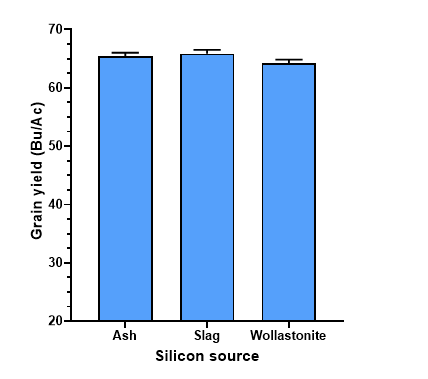
Figure 1. Yield response with different Si source application. The same letter assignment denotes an insignificant difference at α =0.05.

Figure 2. Yield response with Si and N rates. The same letter assignment denotes an insignificant difference at α =0.05.

Figure 3. Grain protein concentration response with varying Si and N rates. The same letter assignment denotes an insignificant difference at α =0.05.

Figure 4. Falling number with varying Si source applications. The same letter assignment denotes an insignificant difference at α =0.05.

Photo: Silica application in the spring of 2025, NWARC, Creston, MT
Acknowledgements:
We thank farm operations staff J. Penney and A. Goodman, without whom this research could not be successful. We also acknowledge R. Barnes, T. Burkhart, J. Cain, A. Mathison, and E. Schreifels for their assistance with field operations, data collection, and sample processing. This study was supported by the Montana Fertilizer Advisory Committee (MFAC).
Link to 2025 Evaluating the Effects of Silicon and Nitrogen Fertilization on Spring Wheat Printable Report (PDF)